Trailers sell graphics. Word of mouth sells gameplay. That single distinction explains why so many visually stunning games fade into obscurity within a month, while some genuinely rough-looking titles stay in regular rotation for years. Players forgive average visuals far more readily than they forgive a game that isn’t fun to actually play.
If you’re deciding where to put your limited time and budget as a creator, understanding this gap matters more than almost any other design decision you’ll make.
Gameplay Is the Experience. Graphics Are the Presentation.
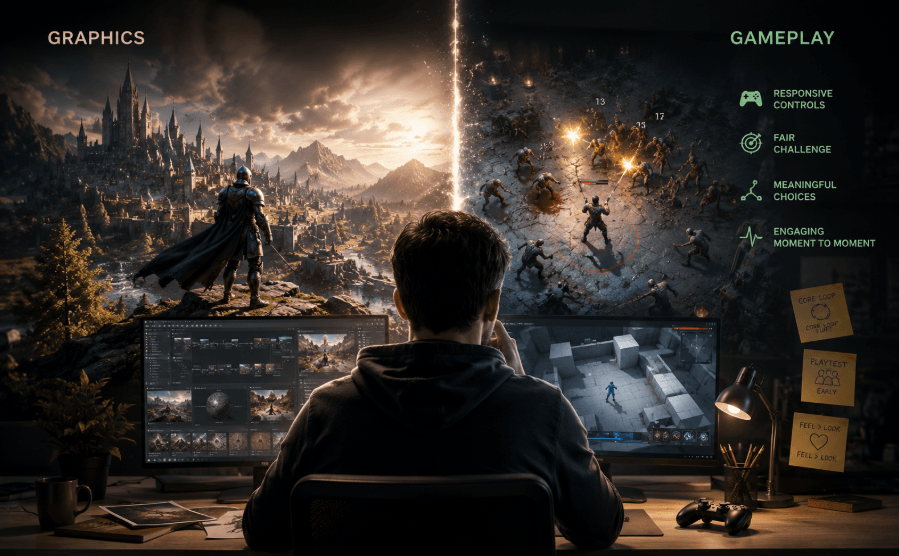
Gameplay covers everything about how a game actually feels moment to moment: the responsiveness of controls, the pacing of challenge, the sense of progress, the small decisions a player makes every few seconds. Graphics are the visual layer wrapped around that experience. One is what you’re doing. The other is what it looks like while you’re doing it.
The confusion happens because graphics are what gets shown in a screenshot or trailer, while gameplay only reveals itself once someone actually sits down and plays. That asymmetry means graphics dominate first impressions, even though they have almost nothing to do with whether someone keeps playing an hour later.
Why Players Forgive Weak Graphics But Not Weak Gameplay
First Impressions Aren’t the Same as Lasting Impressions
A great screenshot gets someone to click download. It has no bearing on whether they open the game again the next day. That second decision is driven entirely by how the game felt to actually play, whether the controls responded well, whether the challenge felt fair, whether there was a reason to come back.
Frustration Compounds, Visual Flaws Don’t
A slightly rough art style doesn’t get worse the longer you play. Clunky controls or unfair difficulty do. Every additional minute spent with bad gameplay makes the frustration more pronounced, while a modest visual style tends to fade into the background once someone is actually engaged in what they’re doing.
Fun Spreads Through Word of Mouth More Than Visuals Do
People rarely recommend a game to a friend purely because it looked nice. They recommend it because it was fun, because they wanted to share the experience, or because they wanted someone to compete against. That kind of organic recommendation is almost always rooted in gameplay, not presentation.
What Strong Gameplay Actually Requires
Responsive, Predictable Controls
Every input should produce a result the player expects, immediately and consistently. Delayed or inconsistent controls break trust between player and game faster than almost anything else, regardless of how good everything else looks.
A Sense of Fair Challenge
Difficulty should feel earned, not arbitrary. Players tolerate losing when they understand why. They abandon games quickly when failure feels random or unfair, no matter how polished the surrounding visuals are.
Constant Small Decisions
The best gameplay keeps players making meaningful choices frequently, not just occasionally. A game like Zombie Survivor illustrates this well, survival-style pressure forces continuous decisions about movement, positioning, and timing, which is exactly the kind of moment-to-moment engagement that keeps a simple concept feeling alive well past the first few minutes.
Momentum That Doesn’t Stall
Good gameplay maintains forward motion. Long stretches without meaningful action or decision-making cause attention to drift, regardless of how the game looks during those quiet stretches.
Why This Matters Even More for Smaller Creators
Big studios can sometimes get away with leaning on visual spectacle because they have the budget to make graphics genuinely competitive. Smaller creators and solo developers rarely have that option, which makes gameplay an even more important place to focus limited time and resources.
This is part of why accessible development tools have found such a strong following among smaller teams. AI games built through natural-language, no-code platforms let creators put their limited time into tuning how a mechanic feels rather than competing on visual production values they were never going to win anyway. When you can’t out-produce a bigger studio visually, gameplay becomes the place where a small team can genuinely compete.
Common Mistakes When Prioritizing Graphics Over Gameplay
Polishing Visuals Before the Core Loop Is Fun
It’s tempting to make a prototype look presentable early, since visible progress feels motivating. But polishing art around a mechanic that isn’t fun yet wastes time twice: once on the art, and again when the mechanic inevitably needs to change.
Assuming Better Graphics Will Fix Player Drop-Off
If players are quitting early, the instinct is often to assume the game needs to look more impressive. In most cases, the actual problem is pacing, difficulty, or control feel, not presentation. Fixing the wrong problem wastes effort without addressing why people are actually leaving.
Treating Playtesting as a Late-Stage Step
Gameplay problems are far cheaper to fix early, before art and content get built around a flawed mechanic. Waiting until a game looks finished to start real playtesting means expensive rework later, when a rough prototype could have caught the same issue in a fraction of the time.
See also: Why Your Amazon Product Listing Fails to Rank for Key Search Terms
How to Prioritize Gameplay in Your Own Process
- Build the core loop first, with placeholder visuals. Confirm the fundamental action is fun before investing in how it looks.
- Playtest constantly, and playtest the feel specifically. Ask whether the moment-to-moment experience is engaging, independent of presentation.
- Fix control and pacing issues before art issues. A visually rough game with tight gameplay outperforms a beautiful game with sluggish controls almost every time.
- Add visual polish once the gameplay holds up on its own. Art should elevate something that already works, not distract from something that doesn’t.
- Watch what players actually do, not what they say about the visuals. Behavior during a playtest reveals gameplay problems far more reliably than feedback about how the game looks.
Final Thoughts
Graphics get a game noticed. Gameplay gets a game played, again and again, by people who genuinely want to be there. Neither is worthless on its own, but when time and resources are limited, and they usually are, gameplay is where that investment pays off the longest.
The games people remember years later are rarely remembered for how they looked. They’re remembered for how they felt to play, over and over, until the mechanic became something close to muscle memory. That feeling is what gameplay builds. Graphics can only ever frame it.