Most business decisions are made with spreadsheets.
Return on investment, cost per acquisition, revenue per employee, client retention rates — the language of earnings is numerical, precise, and reassuringly concrete. Which makes it all the more surprising that one of the most consistently overlooked factors in company performance is something that hangs quietly on a wall and asks for nothing in return.
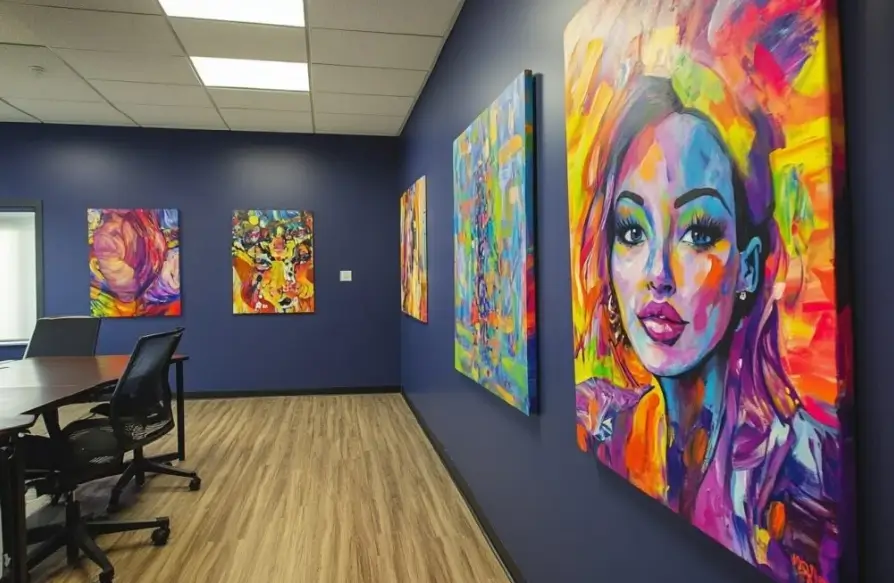
Office art — and specifically, original paintings chosen with genuine intention — has a measurable, documented influence on the three pillars that determine a company’s earnings: the productivity of its people, the quality of the talent it attracts and retains, and the perception of the clients who walk through its doors.
This is not a soft argument about aesthetics. It is a business case supported by research, by corporate practice, and by the accumulated experience of companies that have understood, earlier than their competitors, that the environment in which people work is not separate from the results they produce.
Pillar One: Productivity — The Direct Earnings Link
The most direct line between office art and company earnings runs through productivity.
Research conducted at the University of Exeter by Dr. Craig Knight across multiple controlled workplace studies found that employees working in enriched environments — spaces containing art and natural elements — were approximately 15% more productive than those in lean, minimal spaces. They completed tasks faster, made fewer errors, reported higher concentration levels, and demonstrated greater creative output.
Fifteen percent is a number worth sitting with. Applied to a team of twenty people, it represents the productive equivalent of three additional full-time employees — at no salary cost, no recruitment fee, no onboarding investment. The only cost is the paintings already on the walls.
The mechanism behind this effect is well understood in environmental psychology. The human nervous system evolved in natural, visually complex environments. The stripped, angular, screen-dominated modern office registers as unnatural at a neurological level, generating a low-grade but continuous stress response that depletes the cognitive resources available for actual work. Original paintings — with their organic textures, layered colours, and the visual complexity of a hand-applied surface — partially compensate for this deficit. The eye rests on the painting during natural pauses in concentration. The attention system recovers. The worker returns to the task with renewed capacity.
This is not a marginal effect that compounds slowly over years. Studies measuring cortisol levels — the body’s primary stress hormone — in enriched versus bare office environments have found reductions of up to 61% in the presence of art. Lower cortisol means clearer thinking, better decision-making, more sustained focus, and fewer sick days. Each of these translates, in straightforward accounting terms, into earnings.
A company that invests in original paintings for its offices is not spending money on decoration. It is investing in the cognitive performance of its most expensive asset — its people.
Pillar Two: Talent — The Retention and Recruitment Premium
The second earnings pillar is less immediately obvious but, over time, more financially significant: the effect of office art on a company’s ability to attract, retain, and motivate exceptional talent.
The war for talent is real, and it is expensive. Industry research consistently places the cost of replacing a mid-level employee at between 50% and 200% of their annual salary — accounting for recruitment, onboarding, lost productivity during the transition period, and the institutional knowledge that walks out the door with every departure. Companies that reduce turnover by even a few percentage points generate substantial savings that flow directly to the bottom line.
Physical environment is one of the strongest signals that employees — particularly high-performers with options — use to assess an employer. Not the most important signal, but a consistently significant one. A workplace that has invested in original art communicates something specific and something valuable: that the people responsible for this space have thought about how it feels to be in it. That human experience beyond the transactional has been considered. That this is a company that takes quality seriously — in its work and in its environment.
Research on workplace culture and employer branding finds that employees in aesthetically enriched environments report higher job satisfaction, stronger organisational identification, and greater discretionary effort — the willingness to go beyond the minimum requirements of a role because they feel genuinely invested in where they work.
Discretionary effort is, in earnings terms, pure value. It costs nothing additional and produces results that cannot be mandated or measured in a job description. The company whose employees consistently give discretionary effort outperforms the company whose employees do the minimum — and the physical environment is one of the factors that determines which kind of company you are.
For recruitment, the effect is equally direct. Top candidates assess a potential employer through every available signal during the interview and onboarding process. An office with original paintings on the walls reads differently from one with bare walls or mass-produced prints. It suggests success, taste, investment, and care — qualities that attract people who share those values and who will, in turn, produce work that reflects them.
Pillar Three: Client Perception — The Revenue That Walks in With First Impressions
The third earnings pillar is the one most immediately visible to the outside world: the effect of office art on how clients, partners, and prospects perceive the company they are doing business with.
First impressions form in seconds and are extraordinarily resistant to revision. The moment a client walks into your office, a rapid, largely unconscious assessment is underway — of competence, of reliability, of the kind of organisation this is and whether it is the kind of organisation they want to work with or buy from.
The physical environment is a primary input in this assessment. Research in consumer and client psychology consistently finds that environmental quality — the care, investment, and attention to detail visible in a space — functions as a proxy for the quality of the work produced there. A well-appointed office with original art signals success and standards. A bare or neglected space signals the opposite, regardless of the actual quality of the company’s products or services.
This is not vanity. It is communication. The painting on the wall of your reception area or boardroom is saying something to every client who sees it — about who you are, how you operate, and what you consider worth investing in. Original art, specifically, communicates a level of investment and authenticity that prints and reproductions do not. Clients notice the difference, often without consciously registering why, and factor it into their assessment of whether this is a company worthy of serious business.
In high-value B2B contexts — professional services, finance, consulting, architecture, creative industries — where client relationships are long-term and contracts are significant, the marginal effect of environmental quality on client confidence and retention translates into revenue differences that are substantial and real.
A client who feels, upon entering your office, that they are in the hands of a serious, quality-conscious organisation is more likely to sign, more likely to return, and more likely to refer. The paintings on your walls are part of what creates that feeling.
The Compounding Effect
What makes the earnings case for office art particularly compelling is that these three effects — productivity, talent, and client perception — do not operate in isolation. They compound.
A company whose employees are less stressed and more productive produces better work. Better work attracts better clients and justifies higher fees. Higher earnings allow further investment in people and environment. A better environment attracts better talent. Better talent produces better work. The cycle reinforces itself, and the original investment in a handful of original paintings sits quietly at the beginning of the chain.
This is not a theoretical model. It is the observed pattern of companies that have taken the physical environment of work seriously — from the technology firms of Silicon Valley that have invested millions in their campus environments to the boutique professional services firms that understand intuitively that the quality of their space reflects and reinforces the quality of their work.
The scale of the investment need not be corporate. A small business, a startup, a growing consultancy — any company with a physical space where people work and clients visit — can capture these effects with a thoughtful selection of original paintings at a cost that is modest relative to almost any other business investment.
See also: How Aceget Helps Businesses Achieve Cleaner and More Efficient Diesel Generator Operations
Making the Right Choice
For companies ready to act on this evidence, the practical question is where to begin.
Original handmade canvas paintings deliver consistently stronger effects than printed reproductions across all three earnings pillars — the texture, presence, and authenticity of original work registers differently with the human nervous system and with the human social assessment instinct that evaluates quality and investment.
PastelBrush offers a carefully curated selection of original handmade canvas paintings suited to professional environments across a range of styles, scales, and palettes. Their dedicated office paintings collection brings together works specifically suited to workplace settings — from calming, nature-referenced pieces that support focused individual work to more dynamic compositions that energise collaborative and client-facing spaces.
Every piece is an original canvas, painted by hand, carrying the presence and quality that communicates the right things to the right people — employees, candidates, and clients alike.
The Simplest Business Case
Somewhere in your office, there is a bare wall.
It is not neutral. It is communicating something — to your employees every day, to your clients when they visit, to the candidates who come to interview. What it is communicating, right now, is that this particular aspect of the environment was not considered worth attention.
An original painting changes that message completely. It says: quality matters here. People matter here. This is a place that takes seriously the experience of being in it.
That message, delivered consistently and without effort, to everyone who enters your space — is worth considerably more than the cost of the canvas.
The earnings are in the details. And sometimes, the most important detail is the one hanging on the wall.