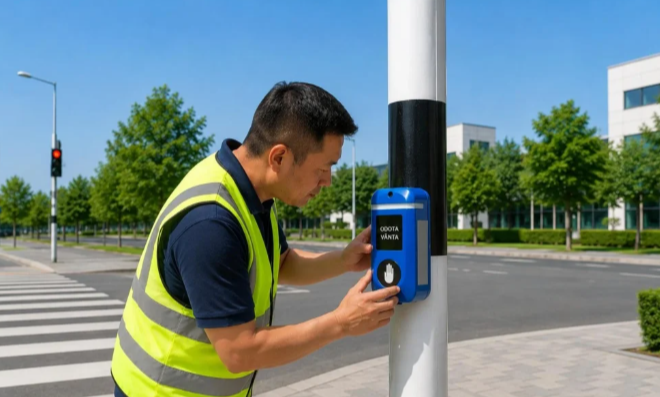
Urban transportation is changing as cities look for ways to improve safety while making public infrastructure more convenient. Pedestrian crossings are one area where technology can make a noticeable difference.
Traditional crossing buttons have served cities for decades, but newer systems can reduce the need for physical interaction. A smart pedestrian crossing system can use contactless detection and intelligent controls to create a more responsive experience for pedestrians and traffic operators.
Why Contactless Crossing Technology Matters
Pedestrian crossing buttons are used by large numbers of people every day.
In a busy city, the same physical button may be touched hundreds or thousands of times.
Contactless technology offers an alternative by allowing users to activate or request a crossing without directly touching the control.
How Detection Can Work
Different technologies can be used to detect pedestrians.
Depending on the system, detection may rely on sensors capable of identifying movement or the presence of a person within a defined area.
The system then processes the detection and responds according to its programmed traffic-control logic.
Faster and More Convenient Interaction
A contactless crossing can make the process simpler.
Instead of searching for a button and physically touching it, a pedestrian may only need to approach or gesture toward a designated detection area.
This can be especially convenient when people are carrying shopping bags, luggage, bicycles, or other items.
Accessibility Benefits
Public infrastructure should be designed for a wide range of users.
Some pedestrians may find traditional buttons difficult to reach or operate.
Contactless activation can provide another interaction method that may be easier for certain users.
Accessibility should still be considered as part of the complete crossing design.
Use Around Public Transport
Transport hubs can have very high pedestrian volumes.
Railway stations, bus terminals, and major intersections may experience continuous movement throughout the day.
Contactless crossing systems can help create smoother interactions in these environments.
School and University Areas
Educational institutions often generate large groups of pedestrians at particular times.
Technology can help authorities manage pedestrian demand while maintaining organized traffic movement.
However, smart systems should be combined with appropriate signage, road markings, speed management, and supervision where necessary.
Reducing Unnecessary Signal Changes
Intelligent detection can help distinguish between periods when pedestrians actually need to cross and periods when no crossing request exists.
This may help traffic signals operate more efficiently.
The exact effect depends on the system configuration and traffic environment.
Weather and Outdoor Conditions
Outdoor equipment must be designed to withstand environmental conditions.
Rain, dust, sunlight, temperature changes, and physical impact can all affect roadside technology.
For this reason, equipment specifications and installation quality are important considerations.
Hygiene and Public Infrastructure
Contactless technology has gained attention because it reduces direct interaction with shared surfaces.
While hygiene is only one consideration in pedestrian infrastructure, it can be a useful secondary benefit of touch-free operation.
Integration With Traffic Signals
A modern crossing system should work with the wider traffic network.
Integration allows pedestrian requests to be processed alongside vehicle signals.
Engineers can program the system according to traffic requirements, pedestrian demand, and applicable regulations.
Maintenance Requirements
Technology does not eliminate maintenance.
Sensors must remain clean and correctly aligned, while electronic components need periodic inspection.
A maintenance program can help ensure that the crossing continues to respond accurately.
Reliability and Redundancy
Road safety systems require a high level of reliability.
Before installation, authorities should consider what happens if a sensor or communication component stops working.
Appropriate fail-safe measures and backup functions should be incorporated according to the system design and local standards.
Data Collection
Connected crossing systems can potentially provide useful information about pedestrian activity.
Authorities may use this information to identify busy periods or locations where additional infrastructure may be required.
Data can support longer-term transportation planning.
Smart Cities
Pedestrian crossings can become part of a broader smart-city strategy.
When connected with traffic monitoring, public transportation, and other infrastructure, crossing systems can contribute to a more coordinated urban mobility network.
Choosing a System
When selecting a smart pedestrian crossing system, city authorities should look at detection accuracy, user accessibility, environmental durability, compatibility, maintenance, and integration with existing traffic infrastructure.
A successful installation should solve a specific transportation problem rather than introduce technology without a clear purpose.
Conclusion
Contactless pedestrian crossing technology offers cities a practical way to modernize public infrastructure.
By reducing physical interaction, improving convenience, supporting accessibility, and potentially providing useful traffic data, smart crossing systems can complement traditional road-safety measures.
The most effective solution is one that combines reliable technology with thoughtful road design, appropriate traffic control, regular maintenance, and the needs of the people who use the crossing every day.