Picture a fairly ordinary Tuesday. You’re scrolling before bed, and a cousin sends a screenshot: some influencer swearing that a new injection called retatrutide “obliterates” Ozempic, that people are losing a quarter of their body weight, that this is the one. You’ve heard enough hype about enough miracle drugs to feel your eyebrows go up. So you do what a careful person does before repeating any of it at Thanksgiving: you go looking for what the actual research says, not what the caption says.
This piece is for that person, the one standing at the intersection of “this sounds too good” and “but what if it’s true.” It’s also for anyone already on semaglutide or tirzepatide who’s wondering what’s coming next, and for anyone who’s been quietly Googling a compound they saw on a forum at 1 a.m. It is not for anyone hoping to be told where to buy it this week, because that’s precisely the part of the story that turns out to matter most.
Who should actually pay attention to this
Retatrutide is worth knowing about if you’re the kind of person who tracks where obesity medicine is heading, or if the current GLP-1 drugs haven’t worked well enough for you, or if you just want to understand what your cousin’s screenshot is and isn’t telling you. It is not, right now, something anyone can responsibly start taking, because it hasn’t finished being tested and it isn’t approved for use by anyone. Holding both of those facts in your head at once, that the results are real and the drug isn’t finished, is really the whole point of this article.
What the science actually shows
Retatrutide is an experimental injectable peptide made by Eli Lilly, tracked in the research world under the code name LY3437943. To understand why people are excited, it helps to know what it’s actually doing inside the body, because the mechanism is the whole reason it exists.
Drugs in this family work by switching on receptors, the biological dials that govern appetite, insulin, and blood sugar. Semaglutide, the active ingredient in Ozempic and Wegovy, flips one dial: GLP-1. Tirzepatide, in Mounjaro and Zepbound, flips two: GLP-1 and GIP. Retatrutide flips three at once, adding a glucagon receptor into the mix. The first two dials do roughly the same appetite-and-blood-sugar work the older drugs already do. The glucagon piece is the new idea, and researchers think it may nudge the body to burn a bit more energy rather than only eating less of it. That third dial is the entire reason this molecule is being studied.
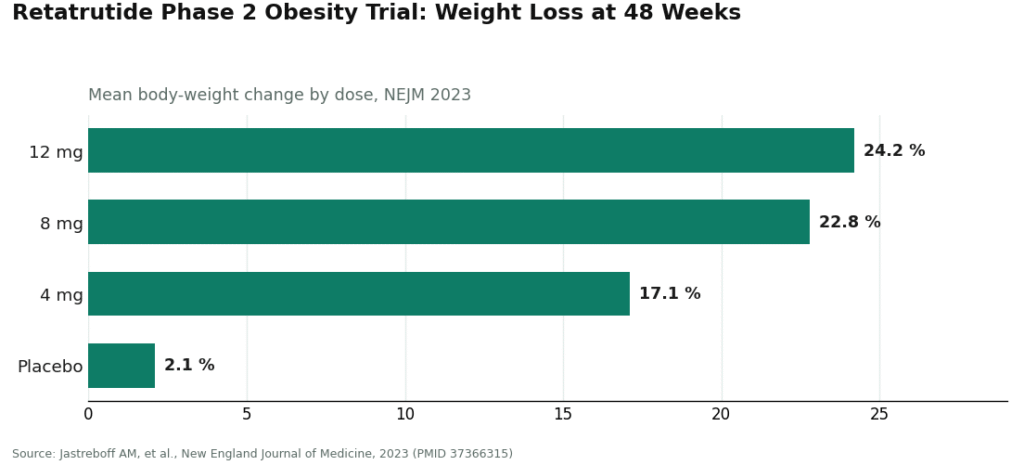
The trial that anchors most of the excitement is a Phase 2 study published in the New England Journal of Medicine in 2023. Adults with obesity were randomly assigned to different doses of retatrutide or to placebo and followed for 48 weeks. At the highest dose tested, 12 mg, participants lost an average of about 24.2% of their body weight, compared with about 2.1% on placebo. The 8 mg group averaged around 22.8%, and the 4 mg group around 17.1% [1]. For context, that top figure is unusually large. Much of the history of obesity medicine involves drugs that struggled to clear single digits, so a randomized trial averaging close to a quarter of participants’ body weight is genuinely rare in this field.
It wasn’t a one-off, either. A separate Phase 2 trial, published in The Lancet in 2023, tested retatrutide in people living with type 2 diabetes, where the main measure was blood sugar rather than weight. There, the highest-dose group saw about a 2.0 percentage-point drop in HbA1c, alongside roughly 17% body-weight loss later in the study, both outperforming the active comparator drug used in the trial [2]. Different population, different main goal, and still the same pattern. Two separate trials, two respected journals, one consistent and sizable result.
The part that gets left out of the screenshots
Here’s where the story most people share stops short. Both of those trials, as encouraging as they are, are Phase 2 studies. In drug development, Phase 2 is the middle chapter: a few hundred participants, often followed for less than a year, meant to show a drug works and to justify the far larger Phase 3 studies that come after, not to replace them. The obesity trial involved a few hundred people over 48 weeks. That’s enough to produce a striking number. It is not enough to know how the drug behaves across thousands of people, over years, in all the different bodies and health histories that make up real life. The confirmatory Phase 3 program, called TRIUMPH-1, was still enrolling and running as of the registry’s most recent listing, tracked under NCT05929066 [3].
And underneath all of it sits the fact that changes everything: retatrutide is not FDA approved for anything. There’s no pharmacy that stocks a brand-name version. It currently exists only inside clinical trials and the supply chain that supports them. That’s the detail that turns “retatrutide beat Ozempic” from a fair description of one trial’s numbers into a misleading picture of where things actually stand, because Ozempic finished the process and got approved, and retatrutide hasn’t.
None of that erases the trial results. It just means the results and the drug’s real-world availability are two different conversations, and the hype tends to collapse them into one.
What it might feel like in your actual body
It’s tempting to stop at the weight-loss number, which is exactly what most social posts do. The trials themselves recorded more than that. The most common side effects were gastrointestinal: nausea, diarrhea, vomiting, and constipation, generally mild to moderate and tied to the dose. Separately, and this is the detail that gets skipped most often, participants showed a dose-dependent increase in heart rate, a cardiovascular signal that researchers are watching closely in the larger trials. It isn’t a dealbreaker on its own, and it fits the pattern seen in this drug class, but it’s exactly the kind of thing that calls for monitoring, not enthusiasm.
In the trials, these effects were managed by starting at a low dose and raising it slowly, in people who’d been screened beforehand and were being watched throughout. That striking top-line number sits at the far end of a careful, supervised process. None of that structure comes with a vial ordered off a website, which matters, because the same biology without the safeguards is a genuinely different and riskier situation than what happened in the study.
What to actually do with this information
Because retatrutide hasn’t been approved as a finished medicine, most of what’s for sale online is labeled a “research chemical,” powder marked “for research use only” or “not for human consumption.” That phrase isn’t just legal boilerplate. It’s the basis the sale rests on, and it’s why nobody is accountable for what’s actually inside the vial. Even a genuine certificate of analysis only describes one batch, and there’s no reliable way for a person to check the identity, purity, or sterility of an injectable powder at home. The FDA has sent warning letters to companies marketing retatrutide outside of clinical trials, which is the regulatory version of the same message the trial data is quietly sending: this compound isn’t finished yet.
So there are really two very different things wearing the same molecule’s name. One lives inside a controlled trial, screened, dosed carefully, watched over time. The other is a package in the mail with a disclaimer printed on it. Chemically they may be the same thing. Everything surrounding them, the screening, the gradual dosing, the follow-up, the accountability, is not, and that surrounding structure is what made the trial’s results safe to produce in the first place.
The version that mirrors the trial’s structure outside of an actual study is a medically supervised one, and it’s worth naming plainly rather than treating it as a sales pitch. FormBlends is a clear example of that clinician-in-the-loop telehealth approach, where a prescriber reviews a patient before any compound enters the picture at all, and their own materials handle retatrutide honestly, naming its investigational status rather than dressing it up as something available today. HealthRX.com (healthrx.com) follows the same reasoning a step further down the list. Neither one is selling retatrutide off a shelf, and that’s the point: retatrutide is investigational, it isn’t a routinely compounded or approved medication, and supervised care is simply the responsible way to think about something this early in testing, not a promise that anyone can hand it to you right now.
What Cora actually thinks, sitting with all of it
Reading through these documents, the trial data holds up. It’s rare for me to say that about a compound with this much online buzz around it, but the numbers are real, they’re large, and they showed up twice, in two different patient groups, in two respected journals.
The catch isn’t in those numbers. It’s that the drug is investigational, that the eye-catching figures come from a mid-stage trial, that the confirmatory studies are still underway, and that what’s floating around online outside of that system is an unregulated chemical with none of the guardrails the actual research relied on. The honest open question was never whether retatrutide works in a trial setting. It clearly does. The real question is whether it holds up at a larger scale, over years, and whether, for any one person, there’s someone actually screening and watching them along the way. No website checkout answers that. The trials are still working on it. Until they do, the fair way to describe retatrutide is a promising, unfinished experiment, worth watching the TRIUMPH-1 results for, and not yet a medicine to start.
See also: Accounting Tips for Real Estate Investors
Common questions people ask me about this
Did retatrutide really beat Ozempic in a head-to-head study? Not in the way that phrase implies. The retatrutide trials never tested it directly against semaglutide in the same study. What people are really pointing to is that retatrutide’s Phase 2 result, about 24.2% weight loss at the top dose, is numerically bigger than what semaglutide showed in its own separate trials [1]. Comparing results across two different trials with different participants isn’t the same as a head-to-head race, and only one of these two drugs has actually been approved.
Can you get retatrutide by prescription anywhere right now? No. As of this writing, retatrutide has no FDA approval for any condition, so there’s no branded product a pharmacy can fill. It currently only exists inside clinical trials and the supply network built to support them. The Phase 3 program, TRIUMPH-1, was still running when the registry was last checked [3].
Why does “for research use only” on the label actually matter? That phrase is the legal ground the sale stands on, not just a disclaimer nobody reads. It signals the product was never manufactured, tested, or released as an actual medicine, which is why no one can be held accountable for what’s genuinely in the vial. A lab certificate for one batch can’t tell you the product is properly identified, pure, or sterile once it’s in your hands.
What side effects showed up in the actual trials? Mostly gastrointestinal ones: nausea, vomiting, diarrhea, and constipation, usually mild to moderate and connected to the dose [1]. The trials also recorded a dose-dependent rise in heart rate, which is exactly the kind of signal the larger studies are designed to keep an eye on. In the trials, all of this happened under slow dose increases and close monitoring, conditions that don’t exist when a powder simply arrives in the mail.
How is the triple-agonist mechanism different from semaglutide or tirzepatide? Semaglutide switches on one receptor, GLP-1. Tirzepatide switches on two, GLP-1 and GIP. Retatrutide adds a third, glucagon, to that pair. Researchers believe the glucagon piece may raise the body’s energy expenditure rather than only reducing appetite, and that third mechanism is the whole reason this particular molecule was developed.
How will I know if retatrutide is actually becoming a real, approved medicine? Keep an eye on the Phase 3 results from TRIUMPH-1, registered under NCT05929066, which is testing the drug in a much larger group over a longer stretch of time [3]. That study is where the Phase 2 results either hold up across thousands of people or don’t, and where more of the long-term safety picture gets filled in. Until those results are in and a regulator has weighed in, retatrutide remains an unfinished experiment rather than something you can actually start.
References
- Jastreboff AM, et al. Triple-hormone-receptor agonist retatrutide for obesity: a Phase 2 trial. New England Journal of Medicine, 2023. Reported ~24.2% mean body-weight loss at 48 weeks on the 12 mg dose vs 2.1% on placebo, with ~22.8% at 8 mg and ~17.1% at 4 mg; most common adverse effects gastrointestinal and dose-related; dose-dependent heart-rate increase noted. PMID 37366315. https://pubmed.ncbi.nlm.nih.gov/37366315/
- Rosenstock J, et al. Retatrutide, a GIP, GLP-1 and glucagon receptor agonist, for people with type 2 diabetes: a randomised, double-blind, placebo- and active-controlled, parallel-group, Phase 2 trial. The Lancet, 2023. Reported ~2.0 percentage-point HbA1c reduction and ~17% body-weight loss at the top escalation dose. PMID 37385280. https://pubmed.ncbi.nlm.nih.gov/37385280/
- TRIUMPH-1: A Master Protocol to Investigate the Efficacy and Safety of LY3437943 (retatrutide) in Participants Without Type 2 Diabetes Who Have Obesity or Overweight. Phase 3, Eli Lilly and Company. ClinicalTrials.gov NCT05929066.
A few quick answers, in plain terms
What is retatrutide and what does it actually do in the body? Retatrutide is an experimental injectable peptide that switches on three gut-hormone receptors at once, GLP-1, GIP, and glucagon, which is why researchers call it a “triple agonist.” Together, those signals tell the brain you’re full, slow down digestion, and appear to push the body to burn a bit more energy. Phase 2 trial data showed average weight loss of roughly 17 to 24 percent of body weight over about 48 weeks, higher than earlier dual-receptor drugs, though the Phase 3 results that would confirm this are still pending.
How would someone actually get retatrutide legally today? You can’t pick it up at a regular pharmacy. Eli Lilly hasn’t submitted retatrutide for FDA approval yet, so there’s no approved commercial version. Some physician-supervised compounding pharmacies, FormBlends among them, operate within regulatory frameworks to compound peptides for patients under a prescriber’s direct oversight. What you’ll also find online are gray-market “research chemical” sellers, and those come with real purity and dosing risks and no one accountable if something goes wrong.
Is retatrutide safe? Based on the Phase 2 data available now, the side-effect profile looks similar to other drugs in this class, mainly nausea, vomiting, and diarrhea that tend to be worst while the dose is being increased. Serious adverse events were uncommon in the trials, but those participants were carefully screened and monitored the whole time. There simply isn’t long-term safety data past about a year yet. Anyone telling you it’s “proven safe” is getting ahead of what the evidence actually shows, and that’s the honest answer.
How is retatrutide powder reconstituted? The general process involves drawing bacteriostatic water into a syringe, injecting it slowly along the side of the vial, and swirling gently, never shaking, until the powder dissolves. How much water you use determines the concentration of every dose you draw afterward, so a small miscalculation there carries through every injection that follows. This is genuinely a step where guidance from a physician or pharmacist isn’t optional, because an early mistake compounds over time.