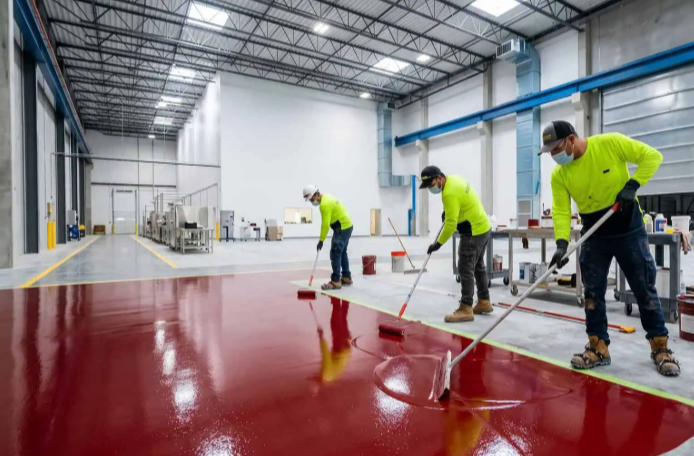
A commercial floor has to do more than provide a walking surface. In busy facilities, flooring contributes to cleanliness, safety, appearance, maintenance efficiency, and the overall working environment.
When the underlying concrete is exposed to constant traffic and daily wear, it can eventually develop stains, cracks, surface deterioration, and other problems. A suitable floor coating can provide an additional layer of protection while creating a surface that is easier to maintain.
For facility managers researching floor coating manufacturers, understanding the practical benefits of different coating systems can make the selection process easier.
Protecting the Concrete Surface
Concrete is durable, but it is not indestructible.
Repeated traffic, impact, moisture, chemicals, and temperature changes can gradually affect its surface.
A suitable coating can act as a protective layer between the concrete and the operating environment.
This can help reduce direct exposure to substances that might otherwise penetrate or damage the surface.
Improving Cleaning Efficiency
Commercial facilities often have strict cleaning routines.
A rough or deteriorated concrete surface can collect dirt and make cleaning more difficult.
A properly selected coating can create a more uniform surface that is easier to sweep, mop, or clean with appropriate equipment.
This can reduce the time required for routine maintenance.
Supporting Workplace Safety
Floor condition can affect workplace safety.
Uneven surfaces, damaged concrete, loose material, and slippery areas can create hazards.
A well-designed coating system can help create a consistent walking surface.
Where required, specialized textures can also be incorporated to improve slip resistance.
Businesses should select the finish according to the actual conditions of the facility.
Improving Visual Appearance
The appearance of a commercial building can influence how customers and employees perceive the space.
A clean, well-maintained floor can make a warehouse, showroom, workshop, or commercial facility look more organized.
Coatings can also provide opportunities to use colors or designated zones.
For example, different floor colors can help distinguish pedestrian paths from equipment areas.
Reducing Surface Wear
Heavy traffic can gradually wear down untreated surfaces.
Warehouses and industrial facilities may experience forklift traffic, pallet movement, rolling equipment, and heavy foot traffic.
The right coating can improve resistance to everyday abrasion.
However, businesses should select the coating according to the specific type and intensity of traffic rather than relying on general durability claims.
Chemical Exposure
Certain workplaces use chemicals, oils, solvents, or cleaning agents.
These substances can affect unsuitable floor surfaces.
Before selecting a coating, facility managers should identify the chemicals likely to come into contact with the floor.
The supplier can then recommend a system with appropriate resistance characteristics.
Moisture Management
Moisture is another consideration.
Commercial kitchens, workshops, garages, storage areas, and industrial plants can experience frequent water exposure.
Moisture can also come from beneath the concrete.
A proper assessment of the existing floor is therefore essential before coating work begins.
Surface Preparation
Preparation is often one of the most important stages of a coating project.
The floor may need to be cleaned and mechanically prepared to remove contaminants and create a suitable surface for adhesion.
Cracks and damaged areas may also require repair.
Skipping preparation can compromise even a high-quality coating.
Choosing the Appropriate System
Different coating technologies are designed for different environments.
Some may prioritize chemical resistance, others abrasion resistance, appearance, quick installation, or specific performance characteristics.
Facility managers should describe the actual application to the supplier rather than choosing a product based only on its general category.
Evaluate the Existing Floor
Before coating, the condition of the concrete should be assessed.
Questions include:
- Is the surface structurally sound?
- Are there visible cracks?
- Is moisture present?
- Are oils or chemicals embedded in the concrete?
- Is the surface contaminated?
- Has a previous coating been installed?
The answers can influence preparation and product selection.
Consider Downtime
Commercial facilities cannot always stop operations for several days.
Businesses should understand how long preparation, application, and curing will take.
A coating system that fits the facility’s operational schedule can reduce disruption.
In some situations, work may be completed in phases.
Long-Term Maintenance
A floor coating should be considered part of a maintenance strategy.
Regular cleaning helps preserve appearance and performance.
Heavy impacts should be addressed promptly, and damaged areas should be repaired before they become larger problems.
Manufacturers and installers can provide maintenance recommendations based on the selected system.
Selecting a Manufacturer
When comparing floor coating manufacturers, businesses should evaluate technical documentation, product consistency, application support, and experience with similar environments.
A manufacturer that understands commercial flooring challenges can provide more practical guidance.
It is also useful to discuss expected service conditions before selecting the final system.
Total Cost of Ownership
Initial price is only one part of the financial calculation.
Businesses should consider installation costs, expected lifespan, maintenance, repair requirements, cleaning efficiency, and operational downtime.
A coating that costs slightly more initially may provide better value if it lasts longer and requires less maintenance.
Commercial Applications
Floor coatings can be useful in many settings, including:
- Warehouses
- Workshops
- Retail spaces
- Garages
- Manufacturing facilities
- Commercial kitchens
- Storage areas
- Showrooms
- Service centers
Each environment has different requirements.
Conclusion
A properly selected floor coating can improve the durability, appearance, cleanliness, and usability of commercial flooring.
However, successful results depend on more than the coating itself. Surface condition, preparation, application, environmental factors, and maintenance all influence long-term performance.
Businesses researching floor coating manufacturers should therefore evaluate products according to their specific facility requirements and consider total cost rather than initial price alone.
With thoughtful planning, a suitable coating system can turn an ordinary concrete floor into a more durable and practical surface that supports daily commercial operations.